- Have a question?
- 613-89-Prime (77463)
- 1-866-950-3667
- info@primebenefitsgroup.com
HCSA vs. WSA: How to Choose the Right Spending Account

Dave Dickinson
Senior Partner & Co-Founder, PRIME Benefits Group
More employers are building flexibility into their benefits plans using spending accounts.
Today’s workforce often spans four or five generations, with employees in very different life stages and priorities. Yet many benefits plans are still one-size-fits-all.
Defined contribution benefits offer a practical way to give employees more choice without redesigning an entire plan, and employee surveys show strong demand for personalized wellness benefits.
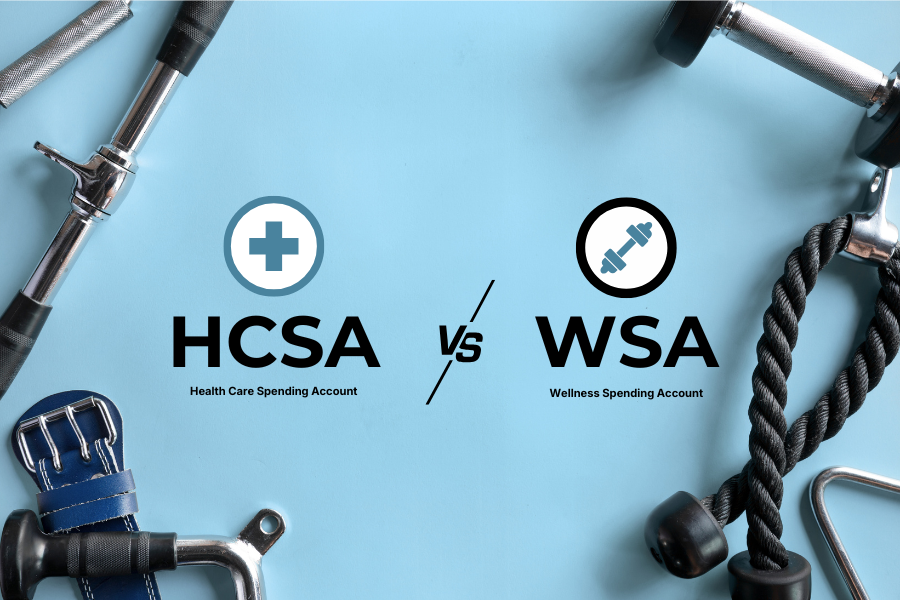
Two common options are the Health Care Spending Account (HCSA) and the Wellness Spending Account (WSA). They’re each designed for different types of expenses and come with different tax considerations.
Here’s how each spending account works, and how to determine the best fit for your workforce.
What’s a Health Care Spending Account (HCSA)?
A Health Care Spending Account (HCSA) is a defined contribution benefit that reimburses employees for eligible medical expenses.
To qualify, expenses must meet the Canada Revenue Agency (CRA) definition of medical expenses under a Private Health Services Plan (PHSP).
How it works
With an HCSA, the employer sets an annual dollar amount per employee. Employees submit claims for qualifying medical or dental expenses, and reimbursements are paid out until the balance is used.
Typical HCSA claims include (but aren’t limited to):
- Dental expenses not fully covered under the core plan
- Vision care
- Prescription drugs
- Paramedical services (physiotherapy, psychology, massage therapy, etc)
- Medical equipment and supplies
HCSA reimbursements are typically tax-free for employees and deductible for employers, which is one of the reasons why they’re so popular.
Is an HCSA right for your team?
An HCSA is best viewed as a flexible extension of your core health and dental plan.
It allows employees to allocate benefit dollars based on their personal medical needs.
For example:
- A younger employee might use it for therapy or counselling
- A parent might use it for orthodontics
- An older employee might rely on it for prescriptions or medical devices
This flexibility becomes valuable in a multigenerational workforce. Different life stages come with different health priorities, and an HCSA helps close any gaps without forcing employers to redesign their plan every few years.
An HCSA can also support longer-term financial planning. Out-of-pocket medical costs can have an impact on retirement readiness as employees age.
What’s a Wellness Spending Account (WSA)?
A Wellness Spending Account (WSA) is also a defined contribution benefit. The difference is scope and tax treatment.
A WSA reimburses expenses that are not considered eligible medical expenses under CRA rules. Because these expenses fall outside the medical definition, reimbursements are generally treated as a taxable benefit to the employee.
You may also see this referred to as a Personal Spending Account (PSA). In most Canadian group benefits plans, PSA and WSA are used interchangeably.
How a WSA works
With a WSA, the employer defines eligible categories, and employees submit claims within those categories. Reimbursements are paid out until the annual balance is used.
Typical WSA claims may include:
- Gym memberships
- Fitness equipment
- Sports registration fees
- Financial planning services
- Childcare or eldercare support
- Home office equipment (depending on plan design)
- Wellness or lifestyle programs
Unlike an HCSA, the CRA doesn’t provide a strict list of eligible expenses. That flexibility gives employers more control over what the account supports and allows the program to reflect workplace priorities.
Is a WSA right for your team?
A WSA is designed to support well-being. For some employees, that might mean fitness or mental wellness programs. For working parents, it could mean support for childcare or family activities. For mid-career and late-career employees, it may include financial planning services.
If financial stress is a growing issue in your organization, a WSA can help by reimbursing financial advice, coaching or wellness resources that employees might not otherwise prioritize.
Ultimately, a WSA is less about insurance and more about culture. It shows your team that wellbeing isn’t limited to prescriptions and dental claims.
How much should employers contribute?
There’s no single “right” amount, but most employers start with a set annual dollar value per employee and adjust over time based on budget, plan goals and employee feedback.
Typical HCSA funding ranges between $250 to $1,000 per employee per year, and WSAs are typically funded in the range of $250 to $750 per employee per year.
Employers that want spending accounts to play a bigger role in retention and total compensation often fund them at higher levels.
Should you offer an HCSA, a WSA or both?
The right answer depends on what you’re trying to achieve.
- Choose an HCSA if you want to improve health and dental flexibility within CRA medical guidelines, while maintaining tax efficiency for employees.
- Choose a WSA if you want to support lifestyle and wellbeing priorities, such as fitness, caregiving support or financial planning.
- Offer both if you want a layered flexible benefits strategy that reflects a wider range of employee needs across life stages.
In many workplaces, a combined approach provides the most balanced solution. Some employers also choose a hybrid approach by combining a spending account with a more traditional pooled benefits plan to create offerings with both stability and flexibility.
At Prime Benefits Group, we can help you evaluate whether a spending account or a combined approach makes the most sense based on your workforce.
Contact our team if you’d like to explore how spending accounts could fit into your plan. We’ll walk you through the structure, tax considerations and strategic impact so you can make a confident decision.